
Attic Insulation Cost & Benefits for NJ Homes (2026)
attic insulation cost benefits nj 2026 featured
Attic insulation in New Jersey typically costs $1,700 to $2,500, or roughly $1 to $3 per square foot installed. Most Monmouth County homes with an under-insulated attic recover part of that cost through lower summer cooling bills.
Key Takeaways
- Average attic insulation installation runs $1,700 to $2,500 for a typical home, or $1 to $3 per square foot.
- New Jersey sits across climate zones 4 and 5, and the current energy code calls for R-49 to R-60 of attic insulation depending on the zone.
- Households that complete weatherization upgrades, including attic insulation, save an average of $372 a year on energy costs.
- Removing old insulation before a reinstall adds $1 to $1.50 per square foot to the total project cost.
- Insulation older than 15 to 20 years, or under 8 inches deep, is usually undersized for today’s recommended R-values.
What Attic Insulation Actually Does
Attic insulation is a barrier of fiberglass, cellulose, or foam material installed between and over attic joists to slow the transfer of heat through the ceiling. In summer, it keeps hot attic air from radiating down into living spaces. In winter, it does the reverse, keeping warm air from escaping upward.
Without enough insulation, your HVAC system works harder to hold a steady temperature, which shows up directly on the electric bill during a Jersey Shore summer. A thin, patchy, or compressed layer of insulation loses most of its effectiveness even if it technically still covers the attic floor.
Attic Insulation Cost Breakdown for NJ Homes
Pricing depends mostly on attic size, insulation type, and whether old material needs removal first.
| Cost Factor | Typical Range | Notes |
|---|---|---|
| Blown-in insulation (fiberglass or cellulose) | $1 to $2.50 per sq ft | Most common for topping up existing attics |
| Batt insulation | $1 to $2 per sq ft | Better for open, easy-access attics |
| Spray foam | $2 to $4.50 per sq ft | Higher upfront cost, air-seals as it insulates |
| Old insulation removal | $1 to $1.50 per sq ft | Needed if old material is damaged, wet, or has pests |
| Air sealing (gaps, penetrations) | $250 to $750 | Often paired with new insulation for best results |
| Whole-attic project, average home | $1,700 to $2,500 | Labor and materials combined |
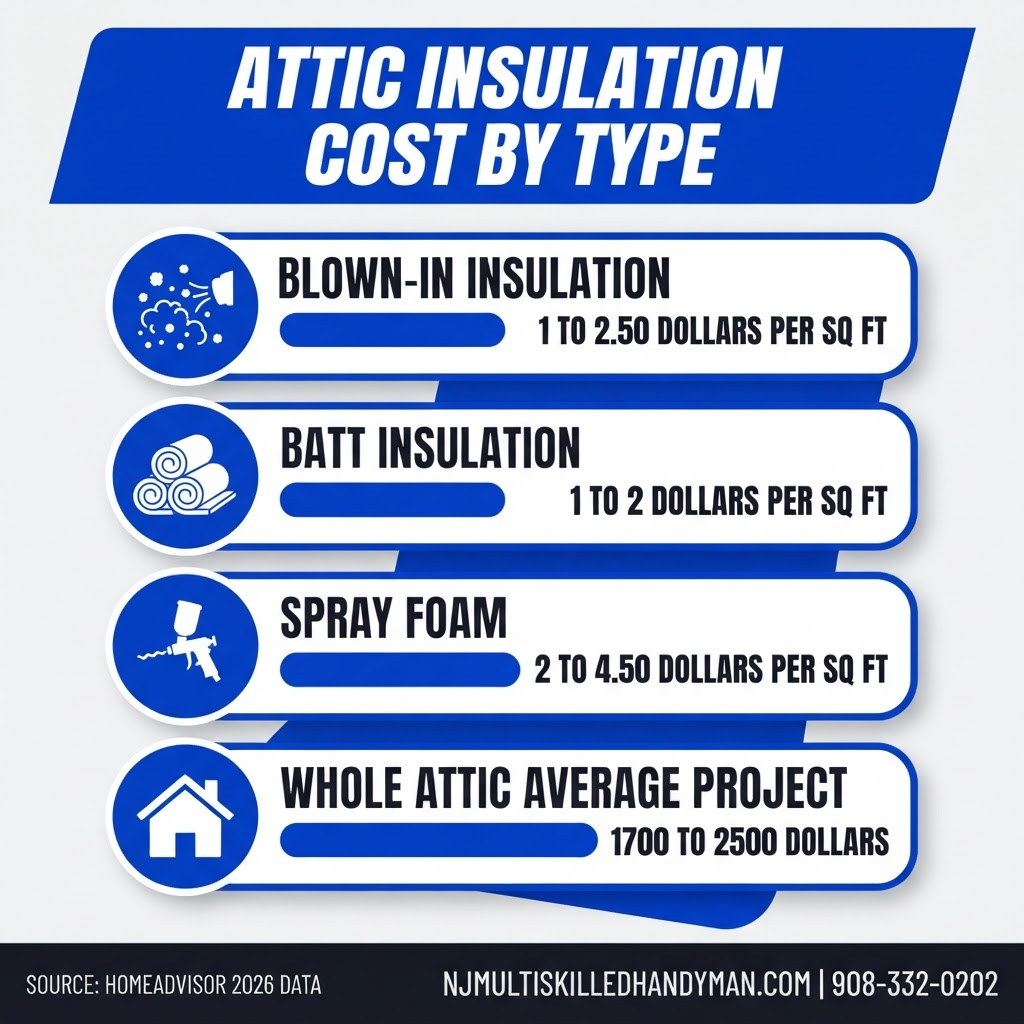
Attics that already have some insulation but not enough usually cost less to top up than attics needing a full removal and reinstall.
How Much R-Value Does Your Attic Actually Need?
R-value measures how well a material resists heat flow. A higher R-value means better insulating performance for the same thickness.
New Jersey spans two federal climate zones. Southern and coastal counties, including most of Monmouth County, fall in Zone 4, while northern NJ sits in Zone 5. Current guidance recommends R-49 to R-60 in the attic for these zones, which typically means 14 to 20 inches of blown-in fiberglass or cellulose, depending on the material.
If your attic has less than 8 inches of visible insulation, or you can see the tops of the ceiling joists poking through, you’re almost certainly under the recommended level. That gap is where a lot of summer cooling dollars are quietly leaking out.
The Real Savings: What Insulation Does to Your Energy Bill
The Department of Energy’s national weatherization program, which includes attic insulation as one of its core measures, reports that participating households save an average of $372 every year on energy costs. That’s not a one-time number; it’s the kind of savings that compounds year after year as long as the insulation stays intact.
For a shore-area home running central air most of June through September, an under-insulated attic means the AC cycles more often just to hold the thermostat setting. Adding proper insulation doesn’t replace the need for a working HVAC system, but it takes real load off it, which is where the bill savings come from.
Homes built before the 1990s, common throughout Oakhurst and surrounding Monmouth County towns, were often insulated to standards far below today’s recommendations. A lot of the savings potential in older housing stock is sitting untouched in the attic.
Signs Your Attic Needs More Insulation
A few signs point to an under-insulated attic before you even climb up to check.
- Uneven room temperatures, especially upstairs rooms that run hotter in summer and colder in winter than the rest of the house
- High summer cooling bills relative to homes of a similar size nearby
- Ice dams along the roof edge in winter are a sign heat is escaping through the attic and melting snow unevenly
- Visible joists with insulation sitting below the top of the frame
- A cold attic floor in winter that feels noticeably colder than the insulated level should allow
If more than one of these applies, it’s worth having the attic measured against current R-value recommendations rather than guessing.
Insulation Alone Isn’t Always the Whole Fix
Insulation slows heat transfer, but it doesn’t seal air leaks on its own. Gaps around recessed lighting, attic hatches, plumbing stacks, and old wiring penetrations let conditioned air escape no matter how thick the insulation layer is above them.
Air sealing before insulating closes those gaps first, so the new insulation actually performs at its rated value instead of losing effectiveness around every penetration. This matters even more in attics with older knob-and-tube or aluminum wiring, where insulation contact rules affect what materials and clearances are safe to use. Our electrical services team checks attic wiring conditions as part of any insulation project that involves rewiring or fixture work nearby.
If your attic framing needs repair, added venting, or decking before insulation goes in, that work runs through our carpentry services. For the insulation and air sealing itself, our general repair services cover both.
DIY vs. Professional Attic Insulation
Batt insulation in an open, easily accessible attic is a reasonable DIY project for a handy homeowner. Blown-in insulation requires a rented or purchased blower machine, protective gear, and careful coverage to avoid gaps, which is where a lot of DIY jobs fall short of the R-value they’re aiming for.
Spray foam insulation should always be professionally installed. It requires specific mixing ratios and ventilation controls that aren’t practical for a one-time homeowner job.
If your attic also needs air sealing around recessed lights, wiring, or an attic hatch, bundling that work with insulation in a single visit is usually more effective than treating them as separate projects. Homes going through other energy upgrades around the same time, like replacing older windows, often tackle attic insulation in the same season. Our window buyer’s guide covers another common piece of that efficiency puzzle.
If you’re not sure whether your attic is under-insulated or just want a straight answer on what it would take to fix it, a quick call gets you a free estimate. Reach our team at (908) 332-0202.
Frequently Asked Questions
1. How much does it cost to insulate an attic in New Jersey?
Most NJ homes spend $1,700 to $2,500 on attic insulation, or $1 to $3 per square foot. The final price depends on attic size, insulation type, and whether old insulation needs to be removed first.
2. What R-value should my attic have in Monmouth County?
Southern and coastal NJ, including Monmouth County, falls in climate zone 4, where current guidance recommends R-49 attic insulation. That typically means 14 or more inches of blown-in fiberglass or cellulose.
3. Will attic insulation actually lower my summer electric bill?
Yes, though the exact amount varies by home. Weatherization programs that include attic insulation report households saving an average of $372 a year on energy costs, and cooling load in summer is one of the biggest places that shows up.
4. Can I add new insulation on top of old insulation?
In most cases, yes, as long as the existing insulation is dry, unstained, and free of pest damage. Wet, moldy, or compressed old insulation should be removed first, which adds $1 to $1.50 per square foot to the project.