
Replacing an HVAC system in New Jersey costs between $5,000 and $30,000+ in 2026, depending on your home size, system type, and whether you’re switching to a heat pump. HVAC costs rose 15–20% in 2026 due to the R-410A refrigerant phase-out and new SEER2 compliance requirements that mandate larger coils and ECM motors.
If your Monmouth County heating or cooling system is 15+ years old, breaking down more frequently, or costing more to run each year, replacement is likely cheaper than another repair cycle. Spring is the ideal time to price it out — before the summer cooling rush drives prices up and schedules out.
Key Takeaways
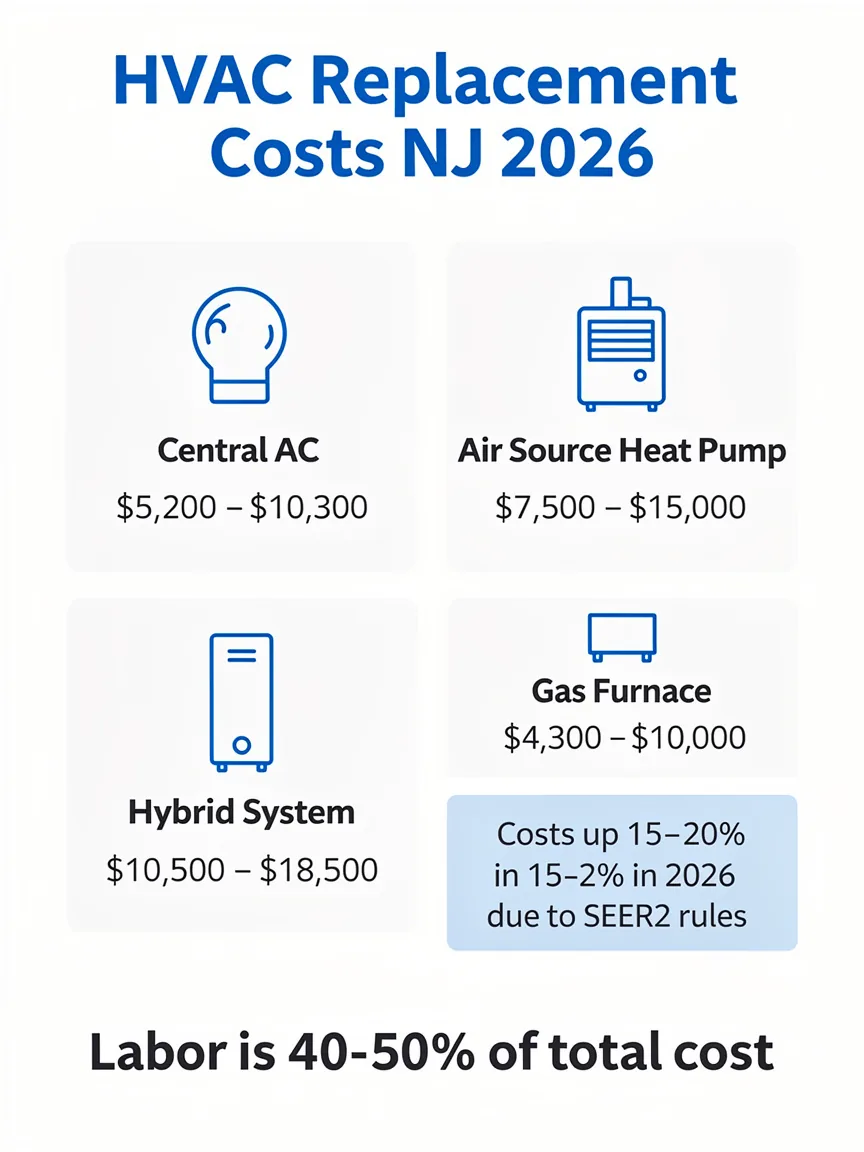
- Central AC replacement in NJ costs $5,200–$10,300 for a SEER2-compliant system including equipment and labor.
- Air-source heat pump installation runs $7,500–$15,000, the fastest-growing system type in NJ, due to year-round heating and cooling in one unit.
- Hybrid systems (gas furnace + electric heat pump) cost $10,500–$18,500 but deliver the lowest annual energy bills.
- HVAC costs rose 15–20% in 2026 due to the R-410A refrigerant phase-out and mandatory SEER2 compliance.
- Labor accounts for 40–50% of the total HVAC bid due to skilled labor shortages and strict installation protocols.
HVAC Replacement Cost by System Type
| System Type | Equipment Cost | Labor & Install | Total Installed Cost | Best For |
|---|---|---|---|---|
| Central AC (SEER2) | $3,200–$5,800 | $2,000–$4,500 | $5,200–$10,300 | Cooling-only replacement, existing furnace is fine |
| Air-Source Heat Pump | $4,000–$9,000 | $3,500–$6,000 | $7,500–$15,000 | Year-round heating + cooling, moderate NJ climate |
| Hybrid (Gas + Heat Pump) | $6,000–$11,000 | $4,500–$7,500 | $10,500–$18,500 | Maximum efficiency, coldest NJ winters |
| Gas Furnace Only | $2,800–$7,000 | $1,500–$3,000 | $4,300–$10,000 | Heating-only replacement, existing AC is fine |
Heat pumps are the standout trend in New Jersey. An air-source heat pump provides both heating and cooling from a single outdoor unit, eliminating the need for a separate furnace. In Monmouth County’s moderate coastal climate, where temperatures rarely drop below 10°F, a heat pump handles 90%+ of the heating load efficiently. On the few coldest nights, the system’s backup heat strips kick in.
HVAC Cost by Home Size
| Home Size | System Size (Tons) | AC Replacement Cost | Heat Pump Cost |
|---|---|---|---|
| 1,000–1,500 sq ft | 1.5–2.0 tons | $5,000–$8,500 | $6,000–$10,000 |
| 1,600–2,200 sq ft | 2.5–3.0 tons | $8,000–$13,500 | $9,000–$14,000 |
| 2,300–3,000 sq ft | 3.5–4.0 tons | $12,000–$19,000 | $13,000–$20,000 |
| 3,100–4,000+ sq ft | 5.0+ tons | $18,000–$30,000+ | $20,000–$30,000+ |
These are full system replacement costs. If you’re only replacing the outdoor condenser (AC) and keeping your existing air handler and ductwork, costs run on the lower end. If the entire system outdoor unit, air handler, ductwork modifications, thermostat, and electrical — needs replacement, expect the higher end.
Why HVAC Costs Jumped 15–20% in 2026?
Three regulatory changes hit the HVAC industry simultaneously this year:
R-410A refrigerant phase-out. The old R-410A refrigerant is being replaced by R-454B (an A2L mildly flammable refrigerant) under federal EPA rules. New systems require leak-detection sensors, different compressors, and redesigned coils — all of which cost more to manufacture and install.
SEER2 efficiency standards. The new SEER2 rating system uses more realistic testing conditions than the old SEER standard. Meeting SEER2 minimums requires larger coils, variable-speed ECM motors, and more precise installation protocols (Manual J/S load calculations, nitrogen brazing, system commissioning).
Skilled labor shortage. The pool of certified HVAC technicians hasn’t kept pace with demand. Labor now accounts for 40–50% of total bids, up from roughly 30–35% five years ago.
These cost increases aren’t going away. If you’re planning an HVAC replacement, doing it in spring 2026 — before the summer cooling rush — gets you ahead of further price increases.
What’s Included in an HVAC Replacement
A full HVAC system replacement in Monmouth County typically includes:
- Manual J load calculation — determining the correct system size for your home’s square footage, insulation level, window area, and climate zone
- Removal and disposal of old equipment — outdoor condenser, indoor air handler or furnace, and associated wiring/piping
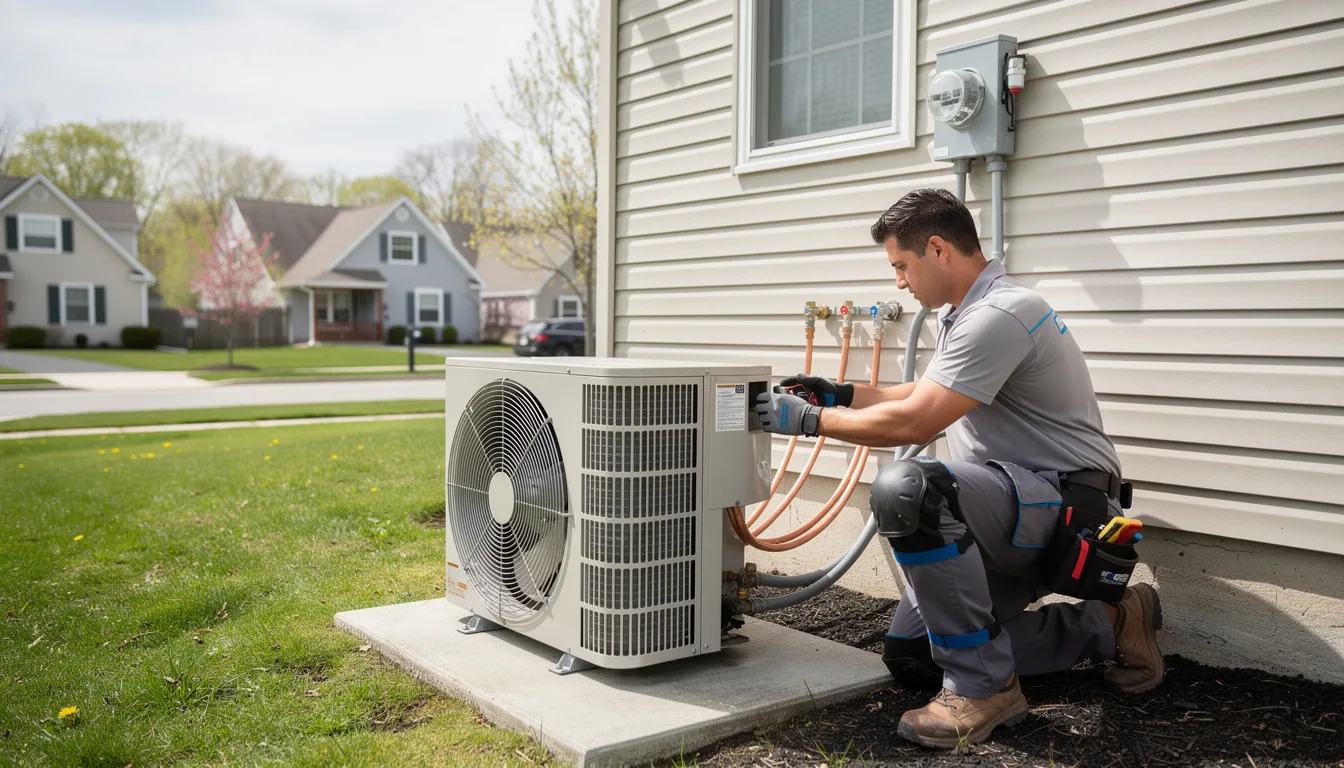
- Installation of a new outdoor unit — AC or heat pump condenser on a level pad with vibration isolation
- Installation of a new indoor unit — air handler or furnace with a new coil, condensate drain, and electrical connections
- Ductwork inspection and modifications — sealing leaks, adding returns if needed, ensuring proper airflow
- New thermostat — programmable or smart thermostat compatible with the new system
- System commissioning — refrigerant charge verification, airflow measurement, temperature split testing, safety control checks
- Municipal permit — required for electrical, ductwork, and A2L refrigerant code compliance
Heat Pump vs. Gas Furnace: Which Is Right for Monmouth County?
For decades, gas furnaces were the default heating system in New Jersey. Heat pumps are changing that equation, especially in coastal Monmouth County, where winters are moderate.
| Factor | Air-Source Heat Pump | Gas Furnace |
|---|---|---|
| Total installed cost | $7,500–$15,000 | $4,300–$10,000 |
| Heating + cooling | Yes — one system does both | Heating only — separate AC needed |
| Energy efficiency | 250–400% (moves heat, doesn’t create it) | 80–98% (burns fuel) |
| Operating cost in NJ | Moderate — electricity rates are above the national average. | Lower — natural gas is relatively cheap in NJ |
| Cold weather performance | Good down to ~10°F; heat strips below that | Excellent at any temperature |
| Environmental impact | Lower — no on-site emissions | Higher — combustion byproducts |
| Lifespan | 15–20 years | 15–30 years |
For an Oakhurst home on the coast, a heat pump handles the vast majority of heating needs efficiently. The few nights below 10°F are managed by backup heat strips. If you’re replacing both your furnace AND your AC, the heat pump’s combined cost is often competitive with buying two separate systems.
When to Replace vs. Repair Your HVAC System
Replace if: – The system is 15+ years old – Repair costs exceed 50% of replacement cost – Energy bills are climbing year over year – The system uses R-22 refrigerant (obsolete, extremely expensive to recharge) – You’re experiencing uneven heating/cooling between rooms – The system is short-cycling (turning on and off frequently)
Repair if: – The system is under 10 years old – The repair is a single component (capacitor, contactor, blower motor) – Repair cost is under $500 – The system has been reliable otherwise
How NJ Multiskilled Handyman Can Help?
HVAC system replacement involves more than just the HVAC unit. It often requires electrical work for new circuits and disconnects, ductwork modifications that touch on carpentry, and sometimes plumbing for condensate drain lines. Our multi-skilled team handles the full scope of supporting trades that an HVAC upgrade requires.
If your Oakhurst home needs electrical panel work to support a new heat pump, condensate drain routing, or smart thermostat wiring, we coordinate it all under one roof. Call us at (908) 332-0202 for a free estimate. We’re available 24/7.
Frequently Asked Questions
1. How much does HVAC replacement cost in New Jersey?
Central AC replacement costs $5,200–$10,300. Air-source heat pumps run $7,500–$15,000. Hybrid systems cost $10,500–$18,500.
2. Why are HVAC costs higher in 2026?
HVAC costs rose 15–20% in 2026 due to the R-410A refrigerant phase-out, new SEER2 compliance requirements, and skilled labor shortages driving up installation costs.
3. Is a heat pump better than a gas furnace in New Jersey?
For coastal Monmouth County homes, a heat pump handles most heating needs efficiently and provides cooling in summer — replacing two systems with one. Gas furnaces are better for inland NJ homes with extended sub-freezing periods.
4. How long does an HVAC replacement take?
A full system replacement typically takes 1–3 days. More complex installations requiring ductwork modifications or electrical upgrades may take 3–5 days.
5. Do I need a permit for HVAC replacement in NJ?
Yes. Most New Jersey municipalities require a permit for HVAC replacement covering electrical, ductwork, and A2L refrigerant code compliance. Your installer should pull the permit.