
Key Takeaways
- Granite and quartz countertops cost roughly the same at mid-grade levels, but granite’s price range is wider because it depends entirely on the slab you choose.
- Granite handles heat up to 1,200 degrees Fahrenheit. Quartz tops out around 300 degrees Fahrenheit. In an active kitchen, that difference matters.
- Quartz is non-porous and never needs sealing. Granite is porous and needs sealing once a year to resist staining.
- Both materials last for decades with proper care. The durability gap comes from maintenance habits, not the stone itself.
- NJ kitchen remodels in older Monmouth County homes often involve countertop spans that aren’t perfectly square, which adds to fabrication time and cost for both materials.
- For busy families with young kids, quartz is typically easier to maintain. For homeowners who love the look of natural stone and don’t mind annual sealing, granite is a legitimate choice.
Granite or quartz? Both are durable, both look good, and both appear in kitchens across Oakhurst and Monmouth County. The right answer depends on how you cook, how much maintenance you want, and what you’re actually willing to spend.
Side-by-Side: What the Numbers Actually Show
Before getting into the nuances, here’s the comparison that matters most for decision-making.
| Category | Quartz | Granite |
|---|---|---|
| Heat resistance | Up to ~300 F | Up to ~1,200 F |
| Porosity | Non-porous | Porous (sealing required) |
| Sealing required | No | Yes, annually |
| Appearance | Consistent pattern | Unique, varies slab to slab |
| Scratch resistance | High | High |
| Chip resistance | Moderate | Moderate (edges vulnerable) |
| Cost range (installed) | Comparable to granite | Comparable to quartz |
| UV / sunlight fade | Yes, it can fade outdoors | Stable |
| Best for | High-traffic kitchens, families | Bakers, high-heat cooking, unique aesthetics |
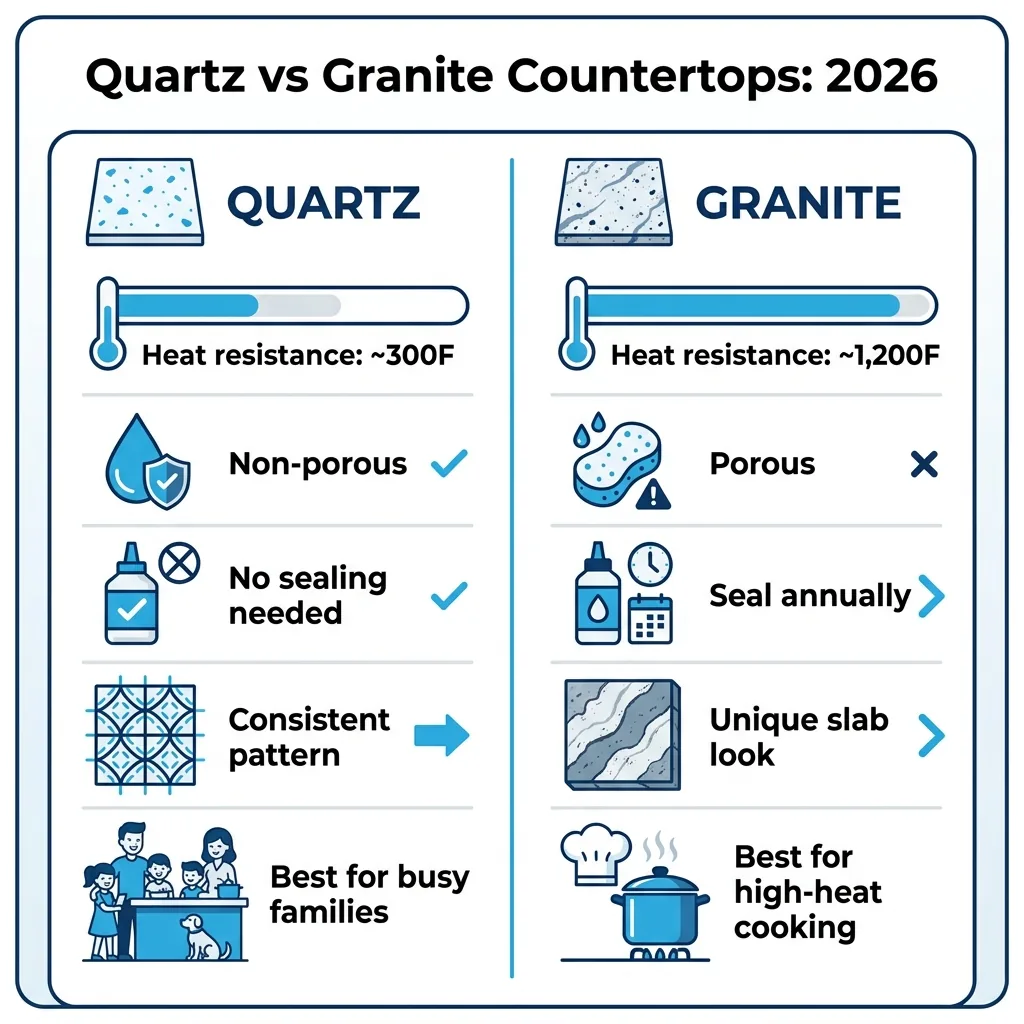
The heat resistance gap is the most meaningful performance difference. Granite can handle up to 1,200 degrees Fahrenheit, while quartz tops out around 300 degrees. That 300-degree limit sounds generous, but a cast-iron skillet pulled straight from the oven can exceed it in seconds. The resin binders in quartz can discolor or crack under that kind of direct heat.
What Quartz Is, and What Granite Is
Understanding the materials helps explain why they perform differently.
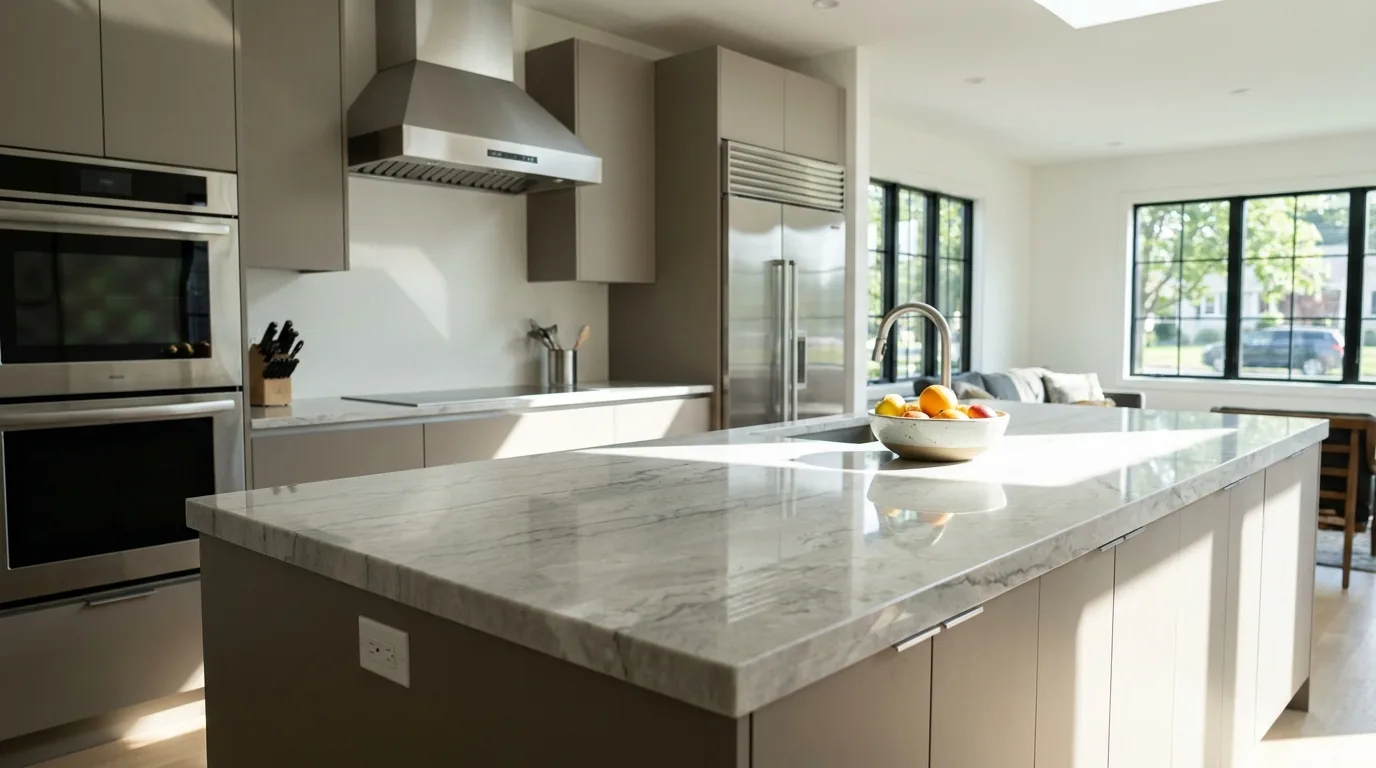
Quartz countertops are engineered stone. They’re made from roughly 90 to 95 percent ground natural quartz crystals bound together with polymer resin and pigments. The manufacturing process creates a consistent, non-porous surface with no natural veins or fissures to trap bacteria or absorb liquids. That consistency is also why quartz has a more uniform look. It doesn’t have the visual variation of a natural stone slab.
Granite is a natural igneous rock. It’s quarried as large slabs, cut to size, and polished. Every slab is unique. The color, pattern, and mineral composition vary by the quarry, by the specific block, and even within a single slab. Granite is porous at the microscopic level. Without proper sealing, liquids and oils can penetrate the surface and cause staining over time.
Both materials rate similarly on the Mohs hardness scale. Both rank around 7 out of 10 on the Mohs scale, so scratch resistance is comparable in normal kitchen use.
The Maintenance Difference Over Time
This is where the two materials split most clearly in daily life.
Quartz needs almost nothing. Wipe it down with mild soap and water. That’s it. No annual sealing, no special cleaners, no concern about leaving a wine glass ring on the counter overnight. For families with young kids and heavy daily kitchen use, that low-maintenance profile is genuinely useful.
Granite needs annual sealing. Sealing a granite countertop is not complicated. You apply a penetrating stone sealer, let it soak in, wipe off the excess, and you’re done. The job takes about 30 minutes and a bottle of stone sealer that typically costs $7 to $15. But it needs to happen every year. Skip it for a few years, and cooking oils and wine will leave permanent stains in the stone.
The other maintenance difference: granite with natural fissures or micro-cracks requires more care about what cleaners you use. Harsh acidic cleaners like vinegar or bleach-based products can etch the sealant and eventually the stone itself.
Our***repair services in Oakhurst, NJ,*** occasionally handle countertop edge repair on both materials. Granite chips are more common on edge profiles, particularly bullnose and ogee edges. Quartz can chip too, but the repair process is slightly more forgiving with color-matched epoxy filler.
When Granite Wins
Choose granite if you bake frequently and routinely place hot pans or baking sheets directly on the counter. The heat tolerance advantage is real, and it matters in that specific scenario.
Choose granite if you want a unique surface. No two granite slabs are identical. If you’re drawn to the variation and character of natural stone, quartz simply can’t replicate that. The engineered consistency of quartz is a feature for some homeowners and a drawback for others.
Choose granite if your kitchen design has warm, earthy tones. Granite’s natural colors tend toward browns, creams, and greens. Quartz can be manufactured in those colors too, but the natural version has a depth that’s hard to match.
Many Monmouth County homeowners doing full kitchen remodels choose granite when they’re also updating the cabinetry to a more traditional or transitional style. See our carpentry services in Oakhurst, NJ if you’re pairing a countertop replacement with cabinet work.
When Quartz Wins
Choose quartz if low maintenance is your priority. Non-porous, no sealing, consistent color, easy cleaning. For a rental property, a secondary kitchen, or any household that doesn’t want an annual maintenance task, quartz is the easier choice.
Choose quartz if your countertop will get sun exposure near a window or in an outdoor kitchen. Quartz resists UV fading slightly better than some sealed granite varieties for interior applications. For fully outdoor settings, neither material is ideal, but quartz’s engineered surface tends to hold up better in that context.
Choose quartz if you want predictable pricing. Because granite is natural, the cost of a slab varies widely based on rarity of the pattern and color. A common granite might cost roughly the same as a mid-grade quartz. A rare exotic granite slab costs significantly more. With quartz, the per-square-foot price for a given product line is fixed and consistent.
Browse our flooring services in Oakhurst, NJ for related surface installation work, or read our guide on sink and vanity installation pricing for 2026 if you’re planning a full kitchen or bathroom refresh alongside the countertops.
The NJ Installation Reality
Countertop fabrication and installation in Monmouth County involves a few factors that national pricing guides don’t always account for.
Older homes in this area often have kitchen runs that aren’t perfectly square or level. Slab fabrication for a 24-foot kitchen with a 90-degree corner requires precise templating. If the walls are out of square, the template has to account for that. Both granite and quartz require on-site templating before fabrication.
Seam placement matters on both materials. On granite, seams are more visible because no two sections of the slab match perfectly. On quartz, seams are also visible but can be placed more strategically because the pattern is engineered to be consistent.
Countertop projects that overlap with plumbing work (new sink cutouts, disposal hookups) benefit from coordinating the countertop install with a plumber who can connect fixtures immediately after the stone is set. Our plumbing services in Oakhurst, NJ handle that coordination routinely.
Not Sure Which Way to Go? Here’s How We’d Frame It.
For most Monmouth County homeowners doing a primary kitchen remodel and planning to live in the home for 10 or more years, quartz is the easier, more practical long-term choice. The zero-maintenance sealing requirement and the non-porous surface genuinely simplify kitchen life.
For homeowners who love to cook, bake, and use their kitchen hard, and who don’t mind the annual sealing task, granite offers heat resilience and a unique aesthetic that quartz can’t match.
Neither material is a wrong answer. Both outlast most of the other finishes in a kitchen remodel. The choice really comes down to how you cook, not which one is objectively better.
Call NJ Multiskilled Handyman at (908) 332-0202 for a free in-home estimate. We’ll take a look at your kitchen layout, talk through the slab options that work for your space, and give you a straight quote for the installation.
Frequently Asked Questions
1. Is quartz of higher quality than granite?
Neither is objectively higher quality. Quartz is engineered for consistent color, non-porous performance, and zero-maintenance sealing. Granite is a natural stone with a unique visual character and superior heat resistance. Quality depends on which properties matter most for your cooking habits and maintenance preferences.
2. Do quartz countertops cost more than granite?
At mid-grade levels, quartz and granite cost roughly the same per square foot installed. Granite’s price range is wider because rare or exotic slabs can cost significantly more than common varieties. Quartz pricing is more predictable because it’s a manufactured product with fixed per-line costs.
3. What is the main downside of quartz countertops?
The biggest limitation is heat sensitivity. Quartz tops out around 300 degrees Fahrenheit before the resin binders can discolor or crack. Placing a hot pan or baking sheet directly on quartz without a trivet is a real risk. Quartz also fades under prolonged direct UV exposure, making it less suitable for outdoor kitchens.