
Key Takeaways
- Check the mantel first. If the wall above the firebox gets too hot to keep your hand on after an hour of fire, the TV should go elsewhere or the mantel needs a deeper heat shield.
- Pull-down or articulating mounts fix the “neck-strain” height problem better than a fixed bracket.
- CPSC estimates about 17,800 emergency-room injuries a year from TV, furniture, and appliance tip-overs, with 2,600 involving only a TV. A properly anchored wall mount removes that risk.
- Fixr cites a typical handyman project of about $300 to install a large flat-screen TV with HDMI cable and an electrical outlet.
- Never run a standard extension cord inside a wall. In-wall power needs a rated kit or a new outlet installed to code.
Mounting a TV above a fireplace works when three things are true: the wall stays cool enough, the screen can come down to eye level, and the wires run inside the wall the right way. Get one of those wrong and you end up with a hot TV, a sore neck, or a cord hanging across the brick.
Is the wall above your fireplace safe for a TV?
The main risk is heat. Wood-burning fireplaces push more heat up the face than many gas inserts. A deep mantel helps by deflecting rising air, while a flat wall with no mantel sends heat straight into the TV.
A quick test: after an hour of normal fire, put your palm flat where the TV would hang. If you can’t keep it there comfortably, don’t mount there without a heat solution.
Also check the TV maker’s manual. Most list a maximum operating temperature. Electronics run hot already, and adding fireplace heat shortens their life.
Gas fireplaces vary. Some direct-vent units are designed with TV-safe walls; others vent heat right where a screen would sit. The manufacturer’s install guide will say.
The height problem (and the fix)
Mantels push TVs high. The center of a TV above a typical mantel ends up far above seated eye level. That is the “too high” complaint people raise most.
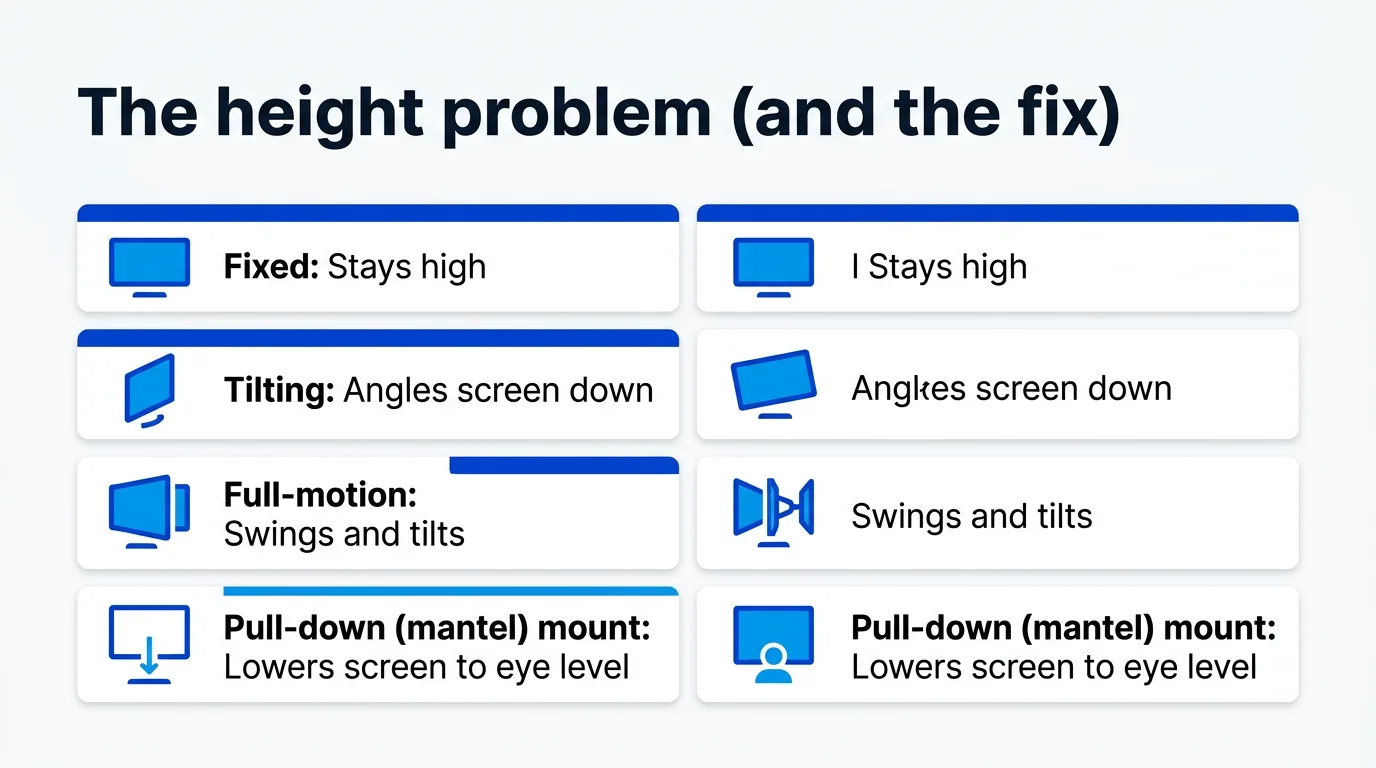
| Mount type | How it handles height | Best fit |
|---|---|---|
| Fixed | Stays high | Rarely watched rooms |
| Tilting | Angles screen down | Moderate mantel heights |
| Full-motion | Swings and tilts | Corner viewing |
| Pull-down (mantel) mount | Lowers screen to eye level | Living rooms with tall mantels |
Pro note: if the room is a main TV room, a pull-down mantel mount is usually worth the extra cost. It lets the screen sit high when the fire is lit and come down for movie night.
What’s behind the wall matters
Fireplace walls are not normal walls. You may find:
- Brick or stone. Needs masonry anchors and a hammer drill. Drill into the brick, not the mortar joint, unless the mount maker says otherwise.
- Drywall over a chase. Studs may be spaced oddly or missing near the flue. Locate framing before you commit to a bracket position.
- Metal flue or chase framing. Keep clearances the fireplace manual requires. Never screw into a metal flue.
Large TVs plus articulating arms put heavy force on anchors. That is why a stud or masonry anchor plan matters more than the bracket brand.
Hiding wires the right way
You have three common options:
- Surface raceway painted to match the wall. Cheapest, fully code-friendly, visible.
- In-wall power and cable kit. A rated kit that uses a recessed outlet behind the TV and a power inlet lower on the wall. Keeps low-voltage and power paths correct.
- New outlet behind the TV. An electrician-style install tied into an existing circuit. Cleanest result.
Do not push the TV’s power cord or an extension cord through the wall cavity. Standard cords are not rated for in-wall use. For more detail, see our guide to hiding wires for a wall-mounted TV.
Costs to plan for
Fixr’s handyman data uses a large flat-screen install with HDMI cable and an electrical outlet as its typical example, at about $300. The overall handyman project range runs $150–$600.
What moves the price:
| Factor | Effect |
|---|---|
| Brick or stone wall | More labor, masonry anchors |
| Pull-down or full-motion mount | Higher hardware cost |
| In-wall power kit or new outlet | Adds parts and time |
| Soundbar or component shelf | Extra mounting |
| Patching and paint after | Small drywall repair |
If the wall needs touch-up after the wiring work, Homewyse puts basic drywall repair at about $297–$472 per repair nationally. Bundling that with the mount saves a second visit.
Safety: why wall mounting beats a stand
Tip-overs are a real household injury risk. CPSC’s tip-over report estimates 17,800 ED-treated injuries per year from TVs, furniture, and appliances, including 2,600 involving a TV alone. A wall mount with the right anchors takes the TV off the furniture entirely.
That safety benefit only holds if the mount is anchored correctly. Undersized drywall anchors are the failure we see most often in DIY installs.
Common mistakes on NJ fireplace walls
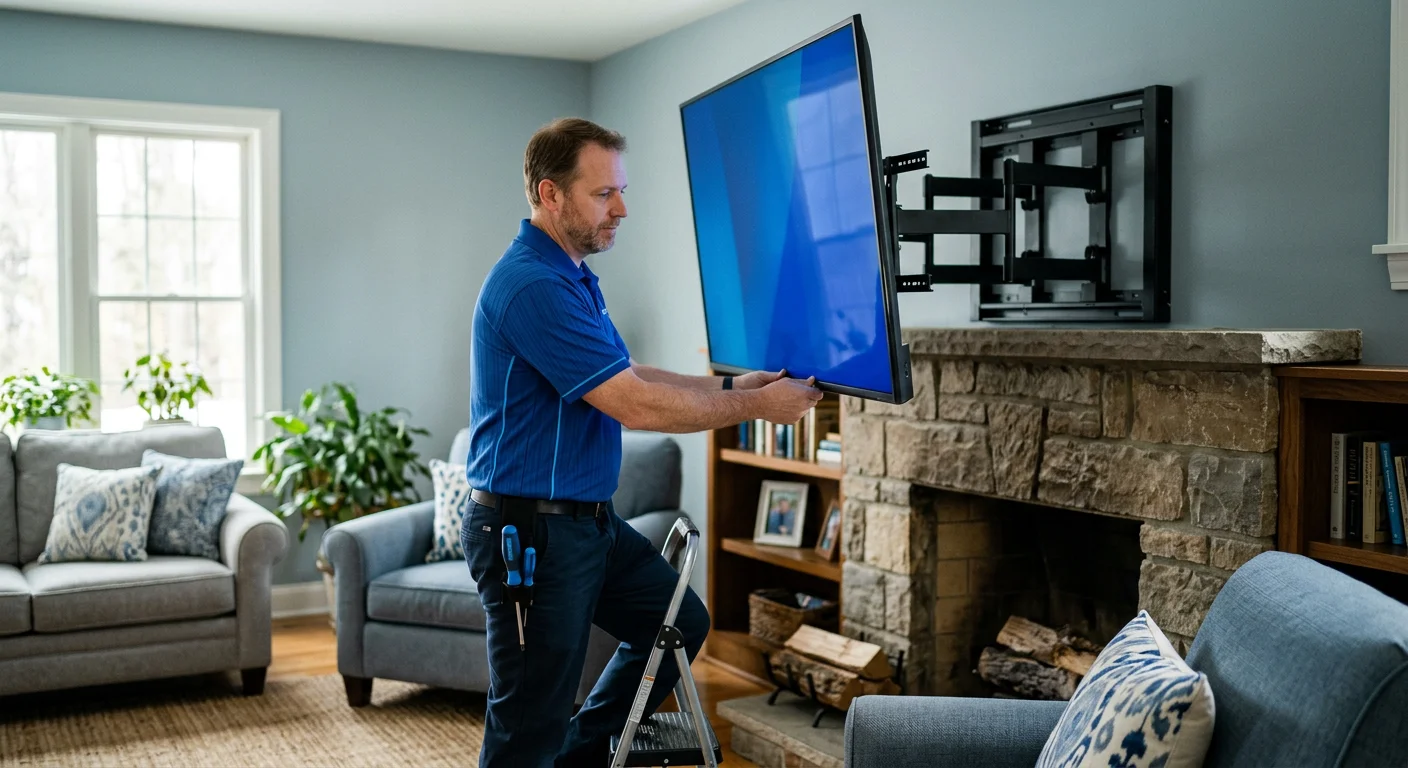
Older Monmouth County homes often have brick fireplaces with plaster walls around them. Plaster cracks easily when drilled. Use the right bit and slower speed.
Newer homes often have gas inserts with stone veneer. Veneer is not structural. Anchor through to the framing or masonry behind it.
Also watch for:
- Mounting before checking the flue location
- Ignoring the TV’s heat rating
- Choosing a fixed mount on a tall mantel
- Using extension cords behind the wall
- Forgetting where the cable box or streaming device will live
New outlets, permits, and older plaster walls
Adding a new outlet behind the TV is electrical work. New Jersey’s Uniform Construction Code requires a construction permit for electrical work on existing buildings, apart from ordinary maintenance. A recessed power kit that plugs into an existing receptacle is a different, simpler path.
The bottom line: Decide on the wiring method before the mount goes up. Changing plans after the bracket is on the wall means a second hole and a second patch.
Older Monmouth County homes add one more wrinkle. If the house predates 1978, cutting or sanding painted plaster can disturb lead paint. EPA’s renovation rule requires lead-safe practices in pre-1978 housing when contractors disturb painted surfaces. Small cutouts with dust control are the norm on those jobs.
If the patch around the new box needs work, our drywall patch guide covers the basic steps.
Fireplace season prep goes with the mount
Fall is when most people decide the TV should finally go over the mantel. It is also when the fireplace starts running again.
Before the first fire, check the damper, clear anything stored on the mantel, and make sure smoke and CO alarms work. If you are already scheduling the mount, it is easy to add weatherstrip and draft fixes around nearby doors and windows. Our winterizing guide lists the quick ones.
When to call a pro
Call when the wall is masonry, when you need a new outlet, or when the TV is large enough that a mistake damages both the screen and the fireplace face.
We handle the mount, the wiring path, and the patch-and-paint after, so the job is one visit instead of three. If the job also needs a door, trim, or shelving tweak nearby, add it to the same visit with our carpentry work or painting touch-up.
If you want a straight answer on whether your fireplace wall can take a TV, call (908) 332-0202. Send a photo of the fireplace, mantel depth, and TV size, and we can usually give a free quote before visiting.
Frequently Asked Questions
Can a TV be hung above a wood-burning fireplace?
Sometimes. It depends on how hot the wall gets and whether a mantel deflects heat. Test the wall after an hour of fire and check your TV’s maximum operating temperature before mounting.
Is mounting a TV above a fireplace too high?
Often, yes, for a fixed mount. A tilting or pull-down mount brings the screen closer to seated eye level and reduces neck strain.
My mounted TV is too high. What should I do?
Swap to a pull-down mantel mount, or relocate the TV to a different wall. Lowering a fixed bracket a few inches rarely fixes the viewing angle.
How do I hide TV wires on a fireplace wall?
Use a painted surface raceway, a rated in-wall power kit, or a new outlet behind the TV. Never run a standard power cord inside the wall.