Electrical panel upgrades in Freehold, NJ typically cost $1,200 to $4,500 depending on amperage and scope, while outlet upgrades and replacements run $150 to $350 per outlet for standard work. If your Freehold home still runs on a 100-amp panel with two-prong outlets and breakers that trip every time the microwave and toaster run together, this guide covers what the upgrade involves and what it should cost.
NJ Multiskilled Handyman serves Freehold from 123 Oakhurst Rd in Oakhurst — about 25 to 35 minutes to most Freehold neighborhoods via Route 33. Our licensed and insured team brings more than 15 years of combined experience across electrical, plumbing, and home repair work.
Key Takeaways
- Panel upgrades in NJ cost $1,200 to $4,500, with 200-amp upgrades running $1,300 to $3,000 for most homes.
- Standard outlet replacement costs $150 to $350 per outlet; GFCI and USB outlets run slightly higher.
- Federal Pacific, Zinsco, and Pushmatic panels are known safety risks and should be replaced regardless of whether breakers are currently tripping.
- All panel work in New Jersey requires a permit and municipal inspection — DIY panel upgrades are not permitted.
- Freehold’s housing stock ranges from pre-war downtown homes with outdated wiring to 1990s builds approaching their first panel replacement cycle.
When Your Freehold Home Needs a Panel or Outlet Upgrade
Electrical systems do not come with expiration dates printed on the panel door, but they give clear warning signs when they are undersized or unsafe.
Signs you need a panel upgrade
- Breakers trip frequently under normal household loads — not just when you plug in a space heater
- Lights flicker when major appliances cycle on
- Your panel is 100 amps and you have added central air, an electric dryer, or other high-draw appliances since the home was built
- The panel brand is Federal Pacific, Zinsco, or Pushmatic — these are documented fire hazards regardless of current performance
- You are adding an EV charger, hot tub, or major renovation that exceeds current capacity
- Rust, corrosion, or burning smell near the panel
- A home inspection flagged the panel during a sale or refinance
Signs you need outlet upgrades
- Two-prong ungrounded outlets in kitchens, bathrooms, laundry rooms, or outdoor locations
- No GFCI protection in bathrooms, kitchens, garages, and outdoor receptacles — required by current NEC code
- Outlets that feel warm, spark, or show discoloration
- Loose outlets that plugs fall out of
- Insufficient outlets for modern use — relying on extension cords and power strips throughout the house
- You are adding USB charging, smart switches, or dedicated appliance circuits
If you are seeing two or more panel warning signs, schedule an assessment before adding new circuits or outlets on top of an overloaded system. Upgrading outlets on a failing panel is like putting new tires on a car with a cracked engine block.
Electrical Panel Upgrade Costs in Freehold NJ: 2026 Guide
| Upgrade Type | Typical Cost Range | Best For |
|---|---|---|
| 100-amp panel replacement | $800–$1,500 | Like-for-like replacement, no capacity increase |
| 150-amp panel upgrade | $1,000–$2,000 | Moderate capacity increase |
| 200-amp panel upgrade | $1,300–$3,000 | Most common upgrade for modern homes |
| 400-amp panel (large homes) | $2,000–$5,000 | Large homes, multi-unit, or heavy EV/solar loads |
| Subpanel addition | $500–$2,000 | Garages, additions, finished basements |
| Federal Pacific / Zinsco replacement | $1,500–$3,500 | Safety-driven, often paired with 200-amp upgrade |
| Permit and inspection fees | $50–$300 | Required in all NJ municipalities |
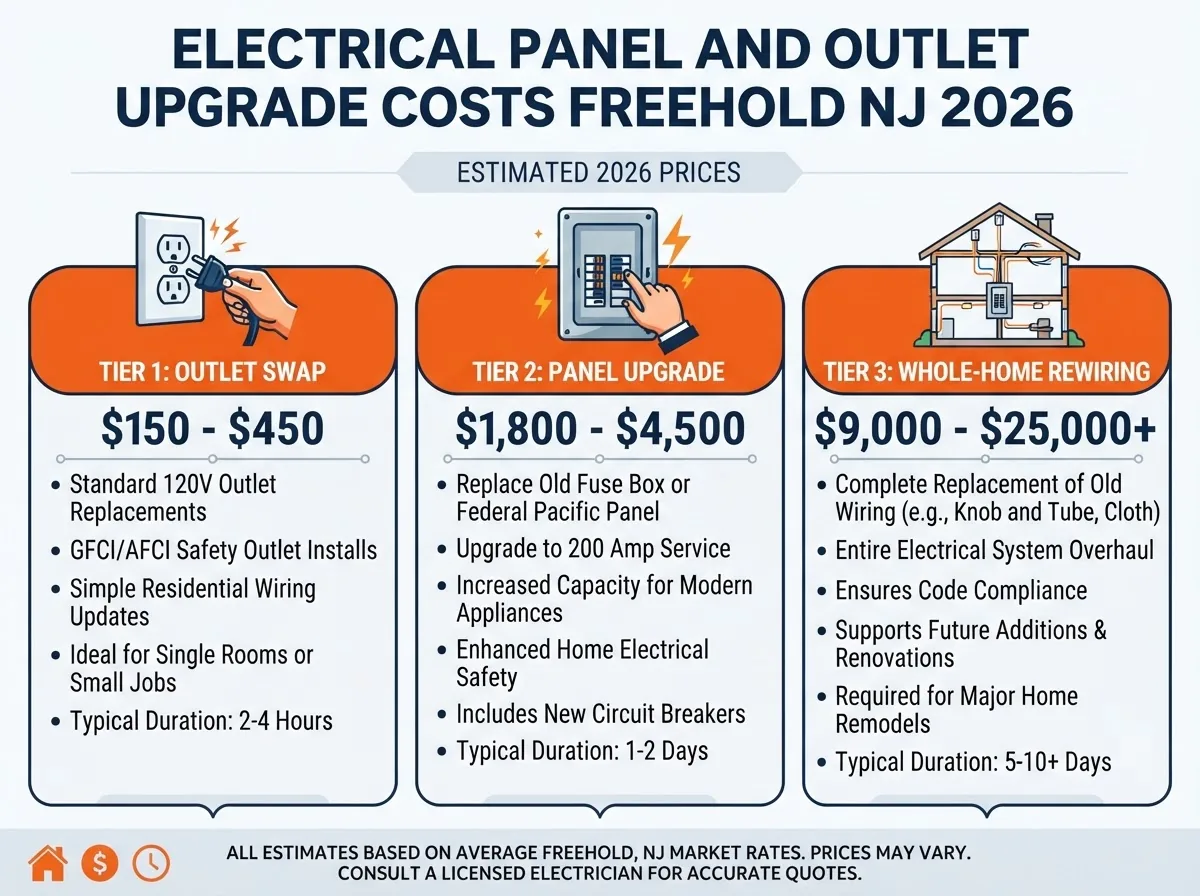
Labor for licensed electricians in New Jersey runs $100 to $200 per hour, with most panel replacements taking a full workday. If the utility company needs to upgrade the service entrance cable or meter base, that coordination adds time and may involve a separate utility appointment.
Outlet Upgrade and Replacement Costs in Freehold NJ
| Outlet Type | Typical Cost Range | Notes |
|---|---|---|
| Standard 15/20-amp outlet replacement | $150–$250 | Existing wiring in good condition |
| GFCI outlet installation | $175–$300 | Required in wet locations per NEC |
| USB outlet installation | $175–$300 | Replaces existing outlet in same location |
| New outlet on existing circuit | $200–$350 | Cutting drywall, running wire from nearest junction |
| New dedicated circuit and outlet | $300–$800 | New homerun from panel — requires open panel capacity |
| Whole-room outlet upgrade (6–8 outlets) | $800–$2,000 | Bundled pricing, depends on wiring condition |
| 240-volt outlet (dryer, range, EV) | $300–$1,200 | Depends on panel capacity and wire run distance |
Replacing a few outlets is straightforward. Upgrading an entire room — or a whole house — from two-prong to grounded three-prong outlets is a larger project that may require running new ground wires or rewiring circuits depending on what is behind the walls.
Freehold Homes and Common Electrical Challenges
Freehold Borough and Freehold Township have different electrical profiles, and both create predictable upgrade needs.
Historic borough homes near downtown often have knob-and-tube or early Romex wiring, ungrounded two-prong outlets, and panels that were upgraded once in the 1980s but never matched to modern load demands. These homes frequently need both panel upgrades and outlet rewiring to meet current code and insurance requirements.
Suburban township homes from the 1970s through 1990s typically have 100-amp or 150-amp panels that handled the original load fine but struggle once homeowners add central air, electric dryers, home offices with multiple monitors, and EV chargers. Federal Pacific and Zinsco panels are common in homes built during this era.
Newer construction from the 2000s usually has 200-amp service, but builder-grade outlets and lack of GFCI protection in all required locations still come up on punch lists and inspection reports.
Regardless of when your home was built, the logic is the same: the panel is the foundation. Outlets are the endpoints. Upgrading endpoints without addressing an undersized or unsafe panel creates new problems on an old system.
The Panel Upgrade Process: What to Expect
A panel upgrade is not a same-day impulse project. Here is the typical sequence for Freehold homeowners.
1. Assessment and estimate. A licensed electrician inspects your current panel, service entrance, grounding, and overall load. You get a written estimate covering the panel, breakers, labor, permit fees, and any additional wiring needed.
2. Permit application. Your electrician pulls a permit from Freehold Borough or Freehold Township before work begins. This is required under the New Jersey Uniform Construction Code.
3. Utility coordination. If the service entrance cable or meter base needs upgrading, your electrician coordinates with JCP&L for a disconnect and reconnect. This may require scheduling a utility appointment separately.
4. Installation day. The electrician shuts off power, removes the old panel, installs the new panel and breakers, reconnects all circuits, and verifies grounding. Most residential panel swaps take 6 to 10 hours.
5. Inspection. A municipal electrical inspector reviews the work before the panel is re-energized. The electrician schedules this — you do not need to arrange it yourself.
6. Power restored. Once the inspection passes, power is turned back on and every circuit is tested.
Our electrical services cover panel upgrades, outlet replacements, dedicated circuits, and EV charger installations for Freehold homeowners. For work that involves opening walls to run new wire — common in older Freehold borough homes — our home repair services handle the drywall patching and finishing after the electrical work is complete.
Outlet Upgrades: GFCI, USB, and Grounding
Not all outlet upgrades are the same. Here is what each type involves.
GFCI outlets protect against ground faults — the kind of electrical shock risk that happens in wet environments. Current NEC code requires GFCI protection in bathrooms, kitchens, garages, basements, laundry rooms, and outdoor locations. If your Freehold home has standard outlets in these areas, upgrading to GFCI is a code compliance and safety improvement.
USB outlets replace a standard outlet with one that includes built-in USB charging ports. No special wiring is needed — they install in the same box as a regular outlet. Popular for kitchens, nightstands, and home offices.
Grounding upgrades are the most involved outlet project. Two-prong outlets without a ground wire cannot simply be swapped for three-prong versions — that creates a false ground that is actually more dangerous. Proper grounding requires either running a new ground wire from the outlet to the panel or replacing the circuit entirely. In older Freehold homes, this is common and should be assessed circuit by circuit.
AFCI protection is required on most living-area circuits in new work and renovations. If you are upgrading a panel, adding AFCI breakers to bedroom and living room circuits is often included in the scope.
Permits and Code Requirements in Freehold
All electrical panel work in New Jersey requires a permit. Outlet work requires a permit when it involves:
- New circuits run from the panel
- Moving an outlet to a new location
- Upgrading service amperage
- Any work in a kitchen, bathroom, or outdoor location that changes the circuit
Simple like-for-like outlet replacements — same location, same circuit, same amperage — may not require a permit in all municipalities, but your electrician should confirm what Freehold Borough or Freehold Township requires before starting.
Only licensed electrical contractors can perform panel upgrades in NJ. Unlicensed electrical work can void homeowner’s insurance, fail inspection at sale, and creates genuine fire and shock hazards. NJ Multiskilled Handyman is licensed and insured for residential electrical work across Monmouth County.
Panel and Outlet Upgrade: DIY vs. Professional
Never DIY:
- Panel upgrades or replacements
- New circuit installation
- Service entrance work
- Any electrical work requiring a permit
Possible DIY (with caution):
- Swapping a like-for-like outlet or switch when you shut off the correct breaker and verify with a tester
- Installing a ceiling fan on an existing fan-rated box and circuit
Hire a professional for:
- Everything else, especially in homes with aluminum wiring, knob-and-tube remnants, or unknown wiring conditions
Electrical mistakes kill people and burn houses down. The savings from a DIY outlet swap are not worth the risk when you are unsure what is behind the wall or which breaker controls the circuit.
Planning Your Electrical Upgrade in Freehold
If you are considering a panel or outlet upgrade, a few decisions upfront save money and prevent rework.
Upgrade the panel first. If your panel is undersized or unsafe, address it before adding outlets, EV chargers, or dedicated appliance circuits. New circuits on an overloaded panel just move the tripping problem to a different breaker.
Bundle outlet work with panel upgrades. If the panel is open and circuits are being reconnected anyway, upgrading outlets on the same circuits costs less than doing it as a separate project later.
Think about future load. Planning to add an EV charger, hot tub, or workshop in the next few years? Size the panel upgrade for what you will need, not just what you use today. Jumping from 100 to 200 amps costs less now than upgrading twice.
Budget for drywall and patching. Older Freehold homes often need small access openings to run new ground wires or circuits. Factor $200 to $500 for patching if your electrician flags access challenges during the assessment.
Call (908) 332-0202 or reach us through our contact page to schedule an electrical assessment. We will inspect your panel, evaluate your outlets, and give you a clear written estimate before any work begins. We offer 24/7 availability for electrical emergencies — sparking outlets, burning smells, or complete power loss.
Frequently Asked Questions
1. How much does an electrical panel upgrade cost in Freehold NJ?
Most panel upgrades run $1,200 to $4,500. A 200-amp upgrade — the most common choice for modern homes — typically costs $1,300 to $3,000 including labor and basic breakers.
2. How much does it cost to replace an outlet in Freehold?
Standard outlet replacement runs $150 to $350 per outlet. GFCI and USB outlets cost $175 to $300. New circuits from the panel cost more — $300 to $800 depending on wire run distance.
3. Do I need a permit for electrical work in Freehold?
Yes for panel upgrades, new circuits, and most outlet relocations. Your licensed electrician pulls the permit and schedules the municipal inspection. Permit fees typically run $50 to $300.
4. Should I replace a Federal Pacific or Zinsco panel even if it works?
Yes. Federal Pacific and Zinsco panels are documented fire hazards. Their breakers often fail to trip under overload conditions. Replacement is a safety priority, not a convenience upgrade.
5. Can a handyman replace electrical outlets in Freehold?
Like-for-like outlet swaps on existing circuits may fall within handyman scope in some cases, but panel work, new circuits, and GFCI upgrades in wet locations require a licensed electrician. When in doubt, hire licensed — the permit and inspection process exists to protect you.